Why Wide Boards Make the Most Luxurious Floor
Stand in a room with a wide-board oak floor and something settles. The eye is not asked to count. The floor stops being a pattern and becomes a surface, and the room reads as one calm plane from wall to wall. It is the reason architects and interior designers reach for wide boards almost by instinct, and the reason a narrow, cheaper board so often looks like a compromise once it is down.
This is what sits behind that instinct, and why width is the first thing to settle when you are choosing a timber floor.
Fewer lines, calmer rooms
Every board joint is a line, and every line is something the eye has to process. A 120mm board puts a joint every 120mm across the room. A 240mm board halves that. Across a four-metre living room that is the difference between roughly thirty-three joints and sixteen, and the room feels it even if no one in it could say why.
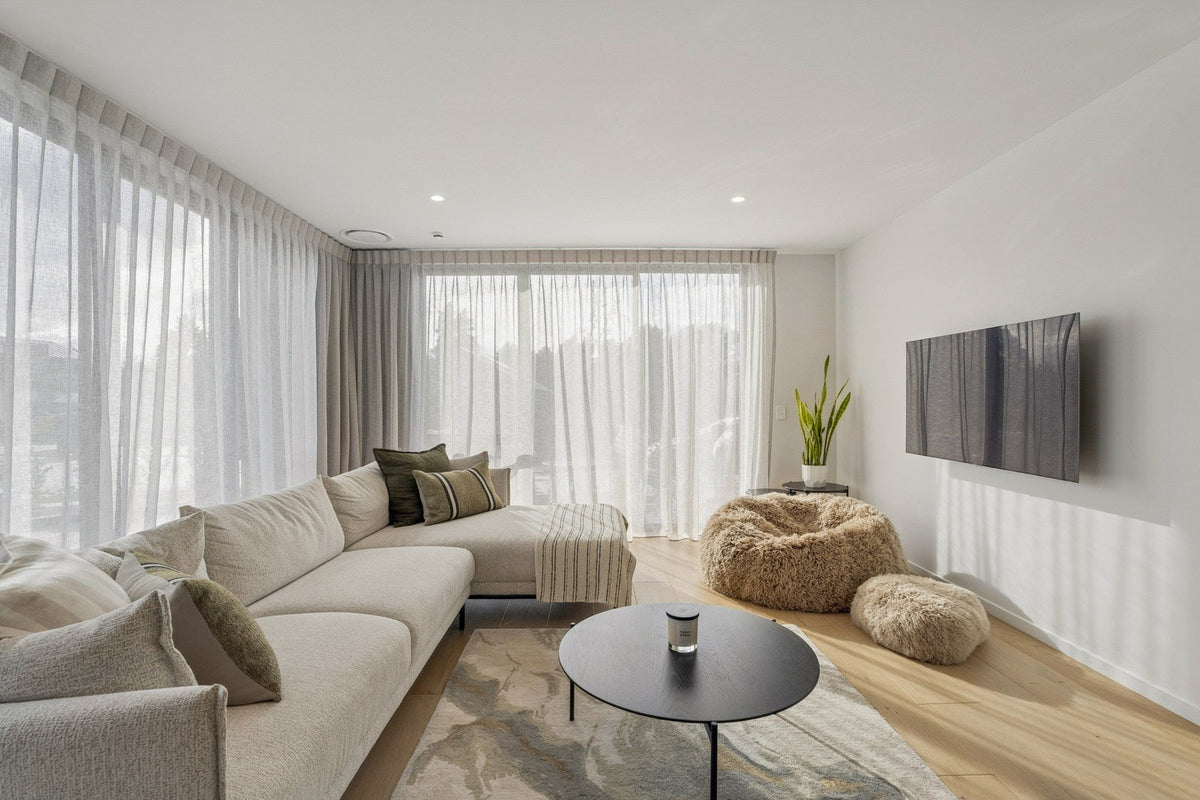
This matters most in the spaces people assume it matters least. In a small room, a narrow board creates a dense, striped field that fights the furniture and makes the walls feel closer. A wide board does the opposite. Fewer lines mean less visual noise, and less noise makes a room feel larger and quieter than its dimensions suggest. It is the same principle that has designers choosing large-format tiles over mosaics in a compact bathroom, or a single slab of stone over a jointed benchtop. Restraint reads as space.
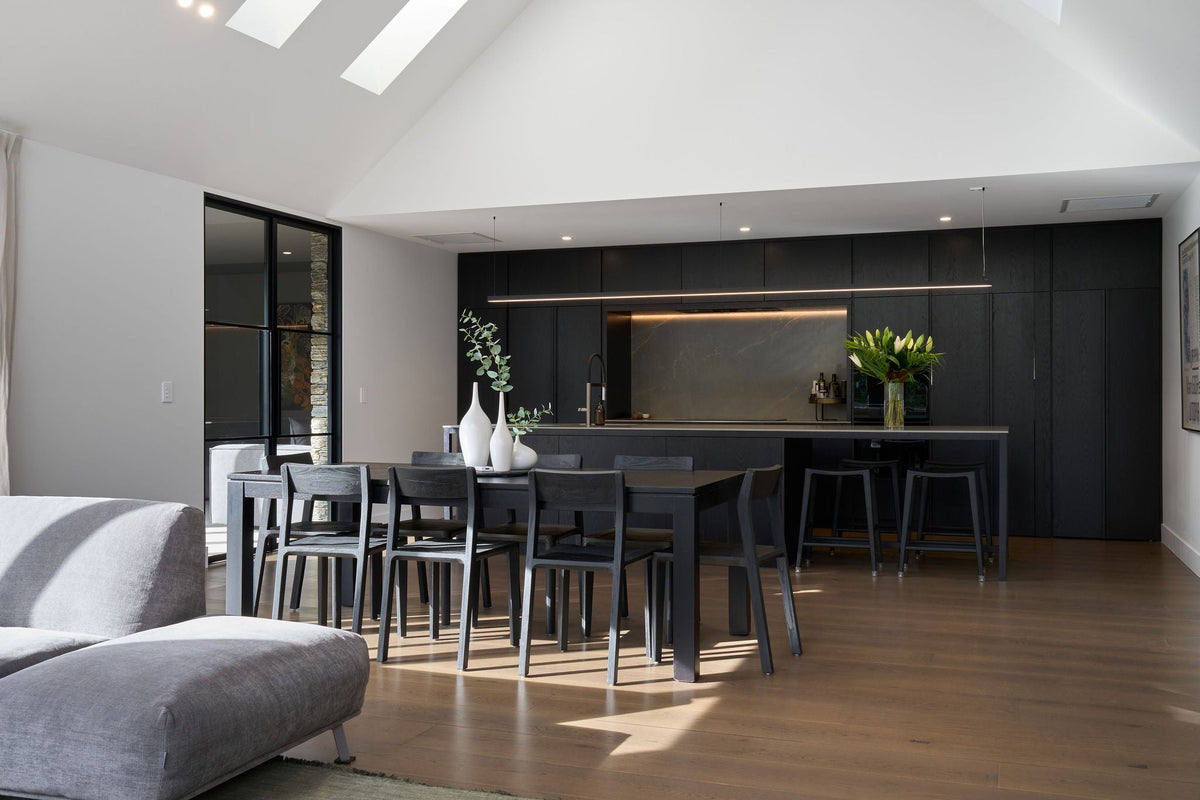
In a large open-plan room the argument shifts but holds. A wide board carries the eye across the floor in long, unhurried strokes rather than a busy grid, so kitchen, dining and living read as one continuous ground rather than three zones stitched together. Where an interior is built from a few honest materials, the floor needs to hold its part of the composition without competing, and width is what lets oak do that.
Sugi House: a 90 square metre argument for wide boards
The clearest proof we know sits in Wānaka. Sugi House, by Condon Scott Architects and built, is a 90 square metre home whose owners came back from a ski trip to Japan having learned to love the efficiency of a small, precisely made space. Barry Condon and his team allocated each function only as much room as it needed, and the result is one of the most decorated small houses in the country.
Underfoot, Condon Scott specified Marchand's 240mm boards in Chocolat. In a house this compact the temptation is to go narrow, on the assumption that a small room wants a small board. The architects did the opposite, and it is the wide board that makes the plan feel generous. With so few joints across each room, the floor reads as a single dark ground beneath the ply and steel, and the eye travels the full length of the house without interruption. The rooms are small. They do not feel it.
The recognition that followed is unusually broad for a house of this size. Sugi House won the Small Project Architecture Award at the 2021 NZIA Te Kāhui Whaihanga Southern Architecture Awards and was shortlisted for the NZIA National Housing Award the same year. It took Silver in the Residential category at the Designers Institute of New Zealand Best Awards, won the Residential Award at Australia's Good Design Awards, and was shortlisted for Habitus House of the Year. In 2022 it received Regional Category Gold at the Southern Master Builders New Zealand House of the Year Awards, in 2024 a Special Mention in the Architizer A+ Awards for private houses under 2,000 square feet, and in 2025 it was named a finalist in HOME Magazine's Home of the Decade Awards, covering the ten years from 2015 to 2025. That is a decade's worth of juries, in New Zealand and abroad, agreeing that a small house built with restraint and honest materials can stand with the best. The floor is part of what they were looking at.
Wider boards come from bigger, older trees
A wide board is not simply a narrow board cut differently. To mill a 240mm face in clear, Prime grade oak, the log has to be wide enough to yield it, and it has to be clean across the full width of the cut, with no knot, check or sap streak interrupting the face. That rules out most of the log and most of the forest. A European oak tree has to grow for well over a century, often much longer, before it can give up boards of that width, and only the best of what it gives will make grade.
That is why width and price travel together. From the same tree, a mill can cut far more narrow boards than wide ones, and the wide ones are the scarce, high-grade fraction of the yield. The narrow, cheaper board on the market is frequently what is left once the wide boards have been taken. When you choose a wide board you are choosing the rarest part of the tree, and the price reflects that scarcity rather than a margin added on top.
There is a second, quieter benefit. Slow-grown oak from the cool forests of Europe lays down tight, even growth rings, and it is this timber that has the stability and the fine, consistent grain to carry a wide face without looking coarse. Fast-grown timber can be cut wide, but it rarely looks it. The refinement in a wide European oak board is in the tree before it is in the mill.
A floor you know you are standing on
Luxury in a home is rarely about display. It is about knowing. The owner of a wide-board oak floor knows what they are walking on: a rare cut of a slow-grown tree, chosen for its face, laid once and intended to outlast the fittings around it. That knowledge is part of the pleasure, in the same way that a solid timber table or a hand-thrown bowl carries its material honesty into everyday use.
It is also an investment in the plain sense. A wide, thick engineered board with a substantial wear layer can be sanded and refinished several times over the decades, so the floor is renewed rather than replaced. Marchand's 240mm boards are 20mm thick with a 6mm solid European oak wear layer, which allows four or five refinishes across the life of the house. A thin, narrow board with a veneer face allows one at most. The wide board costs more on the day and costs less over the years, and it holds its value in the home in a way that a floor chosen on price alone does not. Our cost guide sets out what moves a quote.
What designers weigh when they specify
When an architect or interior designer specifies a wide board, they are usually solving three problems at once. They want the floor to disappear into the architecture rather than announce itself. They want a material that is honest about what it is, because the rest of the palette is built on the same principle. And they want a floor that will still look right when the joinery is replaced in twenty years.
Width answers all three. It also carries through the rest of the house without a change of language: Marchand's herringbone, wall and ceiling boards and stair nosings are cut from the same oak in the same colours and finish, so a wide-board floor can run into a herringbone entry, climb a stair or turn up a wall without a transition.
Choosing a wide board in New Zealand
New Zealand's climate moves between damp winters and dry, heated interiors, and a wide solid board would move with it. This is why wide boards here are engineered: a 6mm oak face bonded to a cross-laminated core that holds its dimension through the seasons, lays glue-down over a concrete slab and takes underfloor heating. The width you want and the stability you need are no longer in tension. If you want the construction detail, our guide to what buyers get wrong with wide plank flooring covers what to check before you commit.
Marchand's boards are 240mm wide and 2200mm long, Prime grade European oak, finished with nine factory coats of UV matt lacquer so nothing is applied on site. Twelve colours, one rate across the range, so the decision is about the room rather than the budget. Samples are free and unlimited anywhere in New Zealand, and the full range can be walked on in our Christchurch, Queenstown and Auckland studios, or talked through in a design consultation.
If you are weighing a wide board against a narrower, cheaper one, stand on both. The difference is not something you need explained.