How Long Does Engineered Oak Flooring Last in NZ?
A Christchurch homeowner contacted us last year after lifting vinyl plank installed seven years earlier. The click joints had swollen, the edges were lifting, and the printed surface had worn through in the hallway. It had been chosen because it was the affordable option.
The question people ask us is how long an oak floor lasts. Nobody can honestly hand you a single number, but you can work it out yourself from one measurement, and we would rather show you how than declare a figure.
The arithmetic
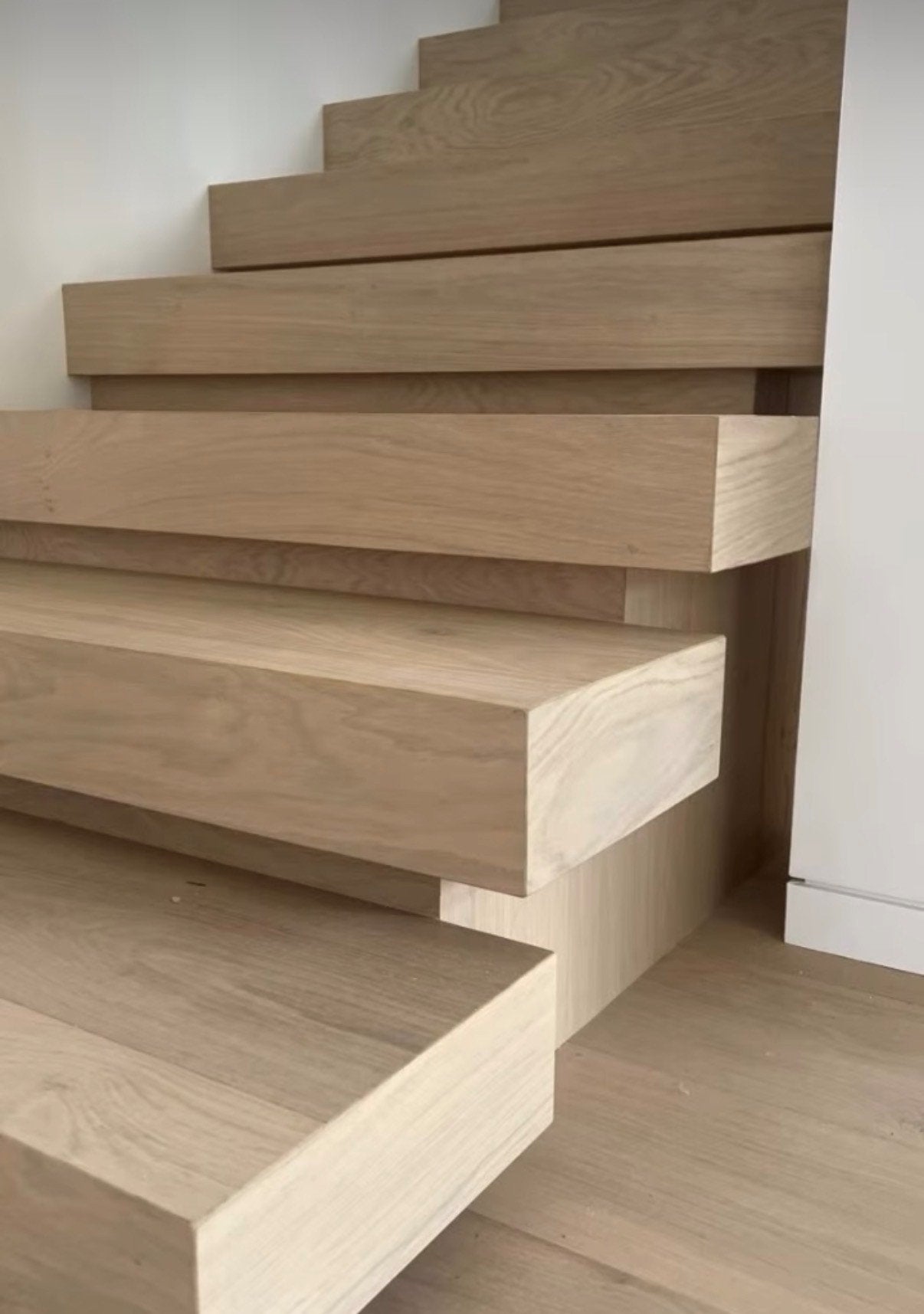
Everything turns on the wear layer, which is the solid oak on top of the board. It is the part that gets sanded, and when it is gone the floor is finished.
Ours is 6mm, published in our Technical Specifications. A full sand removes roughly a millimetre.
You never sand a floor to its last millimetre. Enough oak has to stay on the board to keep it sound and to keep the tongue and groove holding, so the working figure is four or five sands with a safe residual left underneath. That is the re-sandability our manufacturer states, and it is the number to plan around.
How often a floor needs a full sand depends on how it is lived on. In a normal home we see it at somewhere around ten to fifteen year intervals. Multiply that out and the surface has a working life measured in decades rather than years.
Run the same arithmetic on a 2mm wear layer, which is common at the lower end of the market, and there is realistically one sand in the floor. Possibly none, once you allow for the residual and for an installation that was not perfectly flat.
Recoating is not sanding, and the difference matters
This is the part most comparisons miss.
A recoat is a light screen of the surface and a fresh coat of lacquer. It takes no timber off, so it costs you nothing from the wear layer. A full sand takes the surface back to bare oak and consumes about a millimetre.
A floor that is recoated when the lacquer starts to dull will go much longer between full sands than one left until the timber itself is marked. So maintenance is not only about how the floor looks. It directly decides how many decades you get, and the routine is in our After Care Guide.
Why the range is so wide in New Zealand
Auckland averages around 75% relative humidity, and Canterbury sits nearer 65 to 70%. That sounds narrow until you add winter heating that can drop indoor humidity sharply overnight.
Solid timber struggles with that, because it expands and contracts as a single piece. An engineered board with a cross-laminated core has the grain of each layer opposed to the one beside it, so the layers restrain each other and movement stays small and predictable. That is construction rather than marketing, and it is set out in what is inside an engineered oak board.
What actually decides whether you get the decades
- Wear layer thickness. The market runs from about 2mm to 6mm. Ask for the figure, not the adjective.
- Core construction. Cross-laminated, with the grain of each layer opposed. Worth asking, because it is invisible from the surface.
- Moisture at installation. Standard practice is to confirm a slab below 75% relative humidity before laying, with a vapour barrier and proper acclimatisation. This is where most early failures begin.
- Maintenance. A wood-specific cleaner, very little water, and a recoat before the timber itself is marked.
What refinishing costs, against replacing
Refinishing runs at roughly $110 per square metre plus GST across the New Zealand market, including colour. That is the figure worth holding against a replacement, which carries the product, the uplift, the disposal and the installation all over again, plus the disruption of living through it.
Laminate, vinyl and carpet share one characteristic. When the surface fails, the product fails. There is no repair path. An oak floor is the only common floor covering that can be taken back to new without being removed.
A note on the warranty
Our flooring carries a 25 year residential warranty and a 5 year commercial warranty, and the terms are published in full on our Resources page.
A warranty and a service life are different things. A warranty covers manufacturing defect: warping, twisting, delamination. Service life describes how long the surface can be maintained before the board is spent. The second is longer than the first, and any supplier who quotes you a service life should be able to tell you where it comes from.
Ours comes from a 6mm wear layer, a millimetre a sand, and a residual left underneath. That is the whole derivation, and you are welcome to check it.