Oak Flooring Auckland: What to Know Before You Buy
Oak is the most specified premium timber floor in Auckland for good reason. It handles humidity swings, works with underfloor heating, and delivers decades of performance without replacement.
Auckland climate and oak performance
Auckland sits in a subtropical zone with warm, humid summers and mild, wet winters. Auckland averages around 75% relative humidity, and it moves a good deal either side of that across the year. Timber expands and contracts with moisture change, and engineered oak with a cross-laminated plywood core resists this far better than solid timber. That is why it has become the default for Auckland architects and builders.
NZ Building Code E3 compliance
Clause E3 requires building elements to manage internal moisture to protect durability and occupant health. In Auckland, where humidity is consistently high, this matters more than most places.
For a concrete slab we recommend a vapour barrier and proper moisture testing. Industry practice is to confirm slab relative humidity below 75% before any timber goes down. Skipping this is the problem we see most often on Auckland new builds.
Our documented Alternative Solution for NZBC E3 is free to download.
Underfloor heating
Engineered oak is compatible with both hydronic and electric systems. Keep surface temperature below 27 degrees Celsius and use glue-down installation for maximum heat transfer. Thinner profiles conduct heat more efficiently than thicker boards, though both work well within recommended limits. Full detail in our underfloor heating guide.
Installation methods for Auckland conditions
For concrete slabs, glue-down using a flexible adhesive is preferred. It eliminates movement underfoot and maximises contact with the subfloor. For timber subfloors in older villas and bungalows, secret nailing through the tongue is common. Floating installations over an underlay are possible but offer less stability in high humidity.
Acclimatise boards in the room for at least 48 hours before installation.
Service life and long-term value
How many times can this floor be brought back? Four or five. A sand takes roughly 1mm off a 6mm wear layer, and the last of it is never used, because the board needs sound oak beneath the surface and a tongue and groove that still holds. The flooring carries a 25 year residential warranty.
When you factor in removing and replacing a cheaper floor several times over a building's life, premium oak is frequently the more economical choice.
What to look for when buying
Not all oak sold in Auckland is the same. Across the market, wear layers range from about 2mm at entry level to 6mm at the premium end. Anything under 3mm limits refinishing. Confirm the plywood core is cross-laminated rather than aligned grain, which is cheaper but less stable. Ask for the environmental declaration, check the declared service life, and ask who holds the document.
If forestry certification matters to your project, ask who holds Chain of Custody. Our position is set out in full on our Sustainability page.
Auckland projects
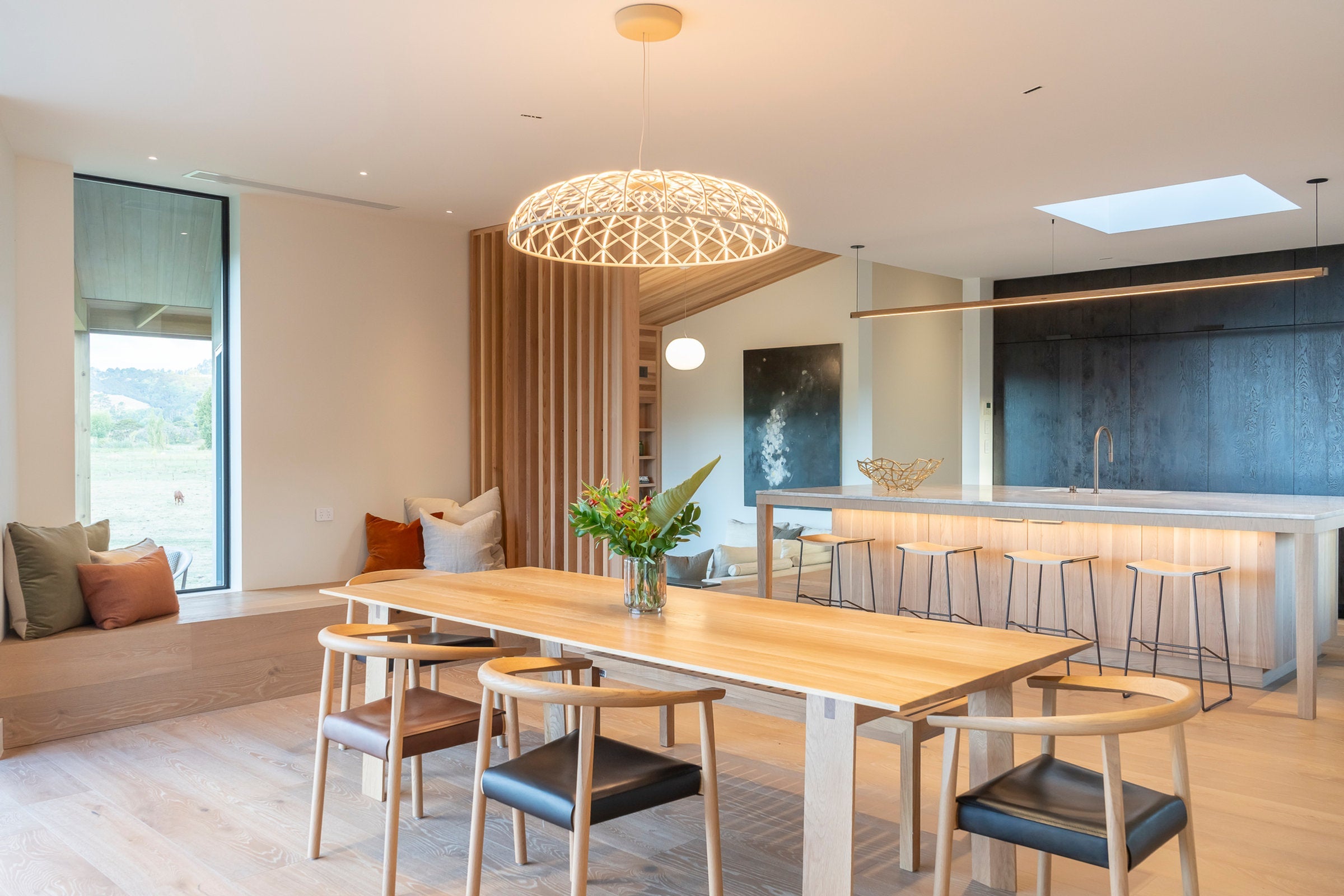
River Terrace with Cate Creemers Architecture uses La Forêt across the main living areas, in a home designed around regenerative principles.
Frequently asked questions
Is engineered oak suitable for Auckland bathrooms?
No. We do not recommend engineered oak on a bathroom floor. Kitchens, sculleries, laundries and powder rooms are appropriate with the recommended detailing, and showers or any area subject to standing water are not suitable at all. The full position, including the detailing, is in oak flooring in wet areas.
Can I install oak flooring over existing tiles?
Yes, provided the tiles are level, firmly bonded and the additional floor height is acceptable. A flexible adhesive applied to clean, roughened tiles is the standard approach.
What does oak flooring cost in Auckland?
Across the New Zealand market, engineered oak product typically runs $90 to $280 per square metre plus GST, with professional installation adding around $100 per square metre plus GST for straight-lay plank. Herringbone takes considerably more labour to lay, so installation can run up to double. Marchand prices at a single rate across every colour. For an indicative figure on your plans, book a consultation. More detail in our cost guide.
See it in person
Visit our Auckland studio, or order a sample board to see the grain in your own light.