Do You Need Expansion Gaps with European Oak Flooring?
Most installation guidance in New Zealand states that engineered timber requires a perimeter movement allowance, typically 10 to 15mm, to accommodate seasonal expansion and contraction.
That guidance is correct, and it is correct for the products it was written for. It is not a universal law of timber. It is a response to how a particular board is built.
Why the gap exists
Timber is a natural material and it responds to humidity. As moisture rises the board swells, as it falls the board shrinks. If a floor expands with nowhere to go, the boards push against fixed walls or joinery, and the results are predictable:
- Cupping or tenting
- Squeaking and friction points
- Gapping between boards
- Damage to tongue-and-groove joints
A perimeter gap is a protective measure against that. Where stability is uncertain, it is the right call, and suppliers who specify it are not being cautious for the sake of it.
The variable that actually decides it
The plywood substrate beneath the oak wear layer.
Engineered flooring is several layers of timber laminated together. In a fully cross-laminated board, the grain direction of every layer is opposed to the one beside it, so the layers restrain each other and movement is small and predictable.
In many products the layers are not fully cross-laminated, meaning grain directions are not consistently opposed. That plywood moves more as humidity changes, and a perimeter gap becomes necessary. Partial cross-lamination is a common way to reduce production cost in this industry, and it is invisible from the surface.
The more movement a board is likely to experience, the more important the gap becomes. The relationship is that direct.
Why our boards do not need one
Our 20mm board is a 6mm solid oak wear layer over a 14mm fully cross-laminated eucalyptus ply core. That construction produces extremely low and predictable dimensional movement, which allows installation without perimeter expansion gaps when the installation follows our guidelines.
The construction reasoning is set out in full in what is inside an engineered oak board.
What this changes in a build
Removing the perimeter gap removes the detail that compromises a great many otherwise clean interiors.
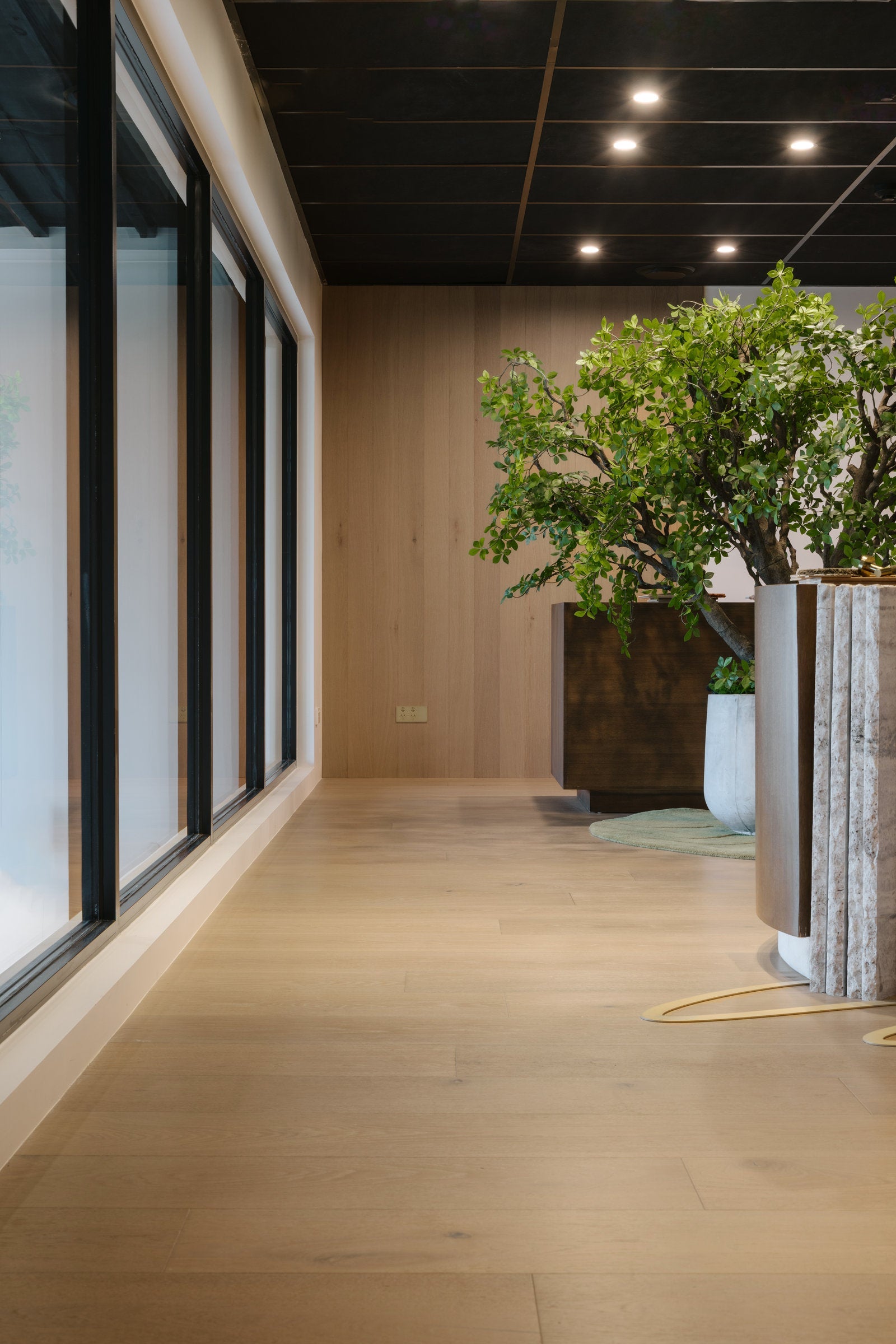
Boards can be butted directly against walls and against aluminium or timber joinery. No scribe, no cover strip, no aluminium trim at the threshold. In a food preparation zone it also removes the void a compliance officer looks for, which we cover in the note on Clause G3.
The condition is that the installation follows the guidelines. This is not a licence to ignore substrate preparation, acclimatisation or adhesive selection. It is a property of the board that only holds when the rest of the installation is correct.
The question to ask
When any supplier tells you an expansion gap is or is not required, ask whether the core is fully cross-laminated. That single answer explains their guidance either way.
Our installation requirements are published in the Installation Instructions, and compliance with them is a condition of the Warranty. Substrate requirements are covered in choosing the right substrate.